So every December, for the last couple years anyway, I’ve been compiling a list of my favorite songs from the previous 12 months: My year-end mixtape, so to say.
Now before we go forward, my list is a little different. And the ground rules are pretty simple. The list is not limited to songs from 2013 (or whatever year it happens to be). They can come from any year … with the following caveat: This list is songs I listened to A LOT in the past year. Some were old, most were new, but all meant something to me. And when I hear these songs in the future, I’ll probably think about 2013.
I’ve been passing out the mixtape for the last couple years, and this time, I’m sharing the track listing here. So enjoy.
In the summer of 2004, a few months before I entered my senior year of high school, I saw the movie Garden State for the first time.
This is almost 10 years ago now. Dubya was still in the process of running for a second term, the Iraq war was in its second year, and the iPhone was still three years away.
And along came Garden State, a little indie flick that seemed predisposed to capture the morose and whiny nature of a generation of 20-something dudes in a post-9/11 America . It was also, depending on whom you asked, the “it” movie of the summer. And it reached this status for a number of reasons. It had a trendy soundtrack (more on The Shins in a minute), a young director (Hey that’s Zach Braff from Scrubs!), and it came onto the scene as an emerging internet culture greased the skids for a more friendly atmosphere for independent movies.
So, of course, I saw the movie that summer, and to put it one way, I was down with Comrade Braff and the movement. Garden State was cool. But it was cool in a way that the bands “Grizzly Bear” or “Sufjan Stevens” are cool. It was sardonic and darkly funny and sort of depressing and also greatly ambitious. But it was all these things … while still also maintaining a level of authenticity. Maybe it was cool because Braff was just a young kid that wanted to make a movie. And he did it. Or maybe Garden State was cool, because you saw it, and the rest of your high school hadn’t. Or something like that.
I hate many things about year-end lists. For one, I hate the phrase you see when you encounter a list — “It’s that time of the year” — which is really code for “OK, here’s a list because we need to provide something to click on while everybody goes on a two-week holiday bender of eggnog and Christmas cookies.”
But I also love many things about these lists. Sure, they’re gimmicky and lazy. But they’re also important. Life is fast, and hard, and busy. And sometimes, we need people to remind us what happened. I have been doing this list here for a couple years now. And I’ll go ahead and recycle what I wrote last year. Sure, it’s lazy. But then again, so are lists.
When I think back to (2012), I know I won’t think of one monolithic theme or narrative. Life doesn’t work that way. Not for me. But I will remember certain moments… and certain songs. So here we go, finally, the 12 songs I will remember from 2012.
Bill Walton served as the color commentator for the Missouri-UCLA game on ESPN on Friday night. It was Walton’s first time on air in some time — he’s apparently been battling health issues — and it turned into a perfect symphony of basketball and poetry.
Walton, calling a game in the same building in which he played in college, was in rare form. Missouri guard Phil Pressey, who had 19 assists, was, according to Walton, a breathtaking savant of basketball genius, a sight to behold, a glorious revelation of playmaking and poise, a gift for all-time. (OK. That’s sort of what he said.)
It all reminded me of the greatest call in the history of basketball… ever.
His name is Mac Lethal, a rapper. He writes fast little rhymes. He posts them on YouTube. Sometimes, they go viral.
It happened again this week.
On Tuesday, Mac Lethal published his latest creation, a video titled “Oh My God! You Need To See This!” (Or at least, I think it was titled that for a while. And then I guess it changed.) It (was) a fantastic title, especially for a video that, presumably, was made to go viral. But the content of the video isn’t all that important. In this case, this was a screed rap against the lunacy of the Westboro Baptist Church, an emotional outburst of words and beats in the wake of the wounds of Newtown, Conn.
But this post isn’t really about Lethal’s latest video, in and of itself. This is more about Lethal, or what he represents, or what talent and ambition represent in today’s free-store culture. I’ll pause to note that these thoughts are incomplete, these ideas bloggy and undeveloped.
But let’s start with Lethal. He is a Kansas City native. Put out a few albums. Raps about the Royals. A year ago, he was living in a somewhat crappy apartment in Overland Park. The kind of place any late 20-something would live.
And for me, this all makes him interesting. He’s been around the KC rap game for years, showing up at shows in Lawrence, hosting shows on the radio, playing a cultural character in a Midwest city with too few of them.
He is not famous. No, not in that way. But if you live in Kansas City, you may have HEARD of him, and you might think you should know who he is, and in this odd Internet age, that can be part of this bizarre realm of not-really-famous fame.
“Hey that’s Mac Lethal. He’s the Kansas City dude who raps insanely fast and writes sort of ironic songs. I guess I’ve heard of him”
Maybe if a Kansas City rapper would have made it big; maybe if Tech N9ne had produced a best-selling, top-40 single, the environment would be different. Not better, mind you; but different.
Last fall, Lethal released a YouTube video of him in a kitchen, spitting out some of the fastest lines you’ve ever heard, an ironically goofy cover (at least, that’s the way I took it) of Chris Brown’s “Look at Me Now”.
The fact that this YouTube video now has more than 27 million views is important to our overall thesis here. But it is, perhaps, just as interesting (although maybe not all that important) that Lethal could gain such click-ified success by rapping lines like: “Gotta butter up another one, and put it on the skillet, another couple minutes until it’s done-done / ain’t nobody fucking with this kid, so tell Jerry Sandusky I’m gonna kill him with a stun gun.”
But all this Internet fame, all this viral success, all this bizarre creation of art, well… it leads to few questions.
What do you do after you create a video with 27 million views… and then go viral again? And has Mac Lethal passed a threshold … an invisible barrier of internet fame, never to return again? I guess what I’m saying is this: If Mac Lethal has ambitions, dreams about being an artist who supports himself on his work… does becoming an Internet sensation hinder this pursuit?
Part of Lethal’s appeal, part of what makes him unique, is how home-made it all feels. He creates a beat on his iPhone, he sits on his couch, he spits out a perfect rhyme on the “first” take, and then he turns the camera off. This is not Rebecca Black, we’re told, or some methodically planned lip-dub proposal; this is hip-hop in its purest form.
And it’s quite brilliant, in its own little way. But here’s the question: When you get 27 million views while rapping about flapjacks, can you maintain authenticity?
***
Seattle is a music city. This is the rep, anyway. For years, a young rapper named Ben Haggerty plowed away in the local hip-hop scene. He performed at local shows, appeared at Seattle sporting events, and earned thousands of clicks on YouTube.
He was not famous. But he was notable. A white rapper from Seattle with a little bit of talent. If you asked people around the Seattle scene, they might say something like… “Yea, I’ve sort of heard of him.”
But how does somebody like this break through?
Earlier this year, Haggerty released a song called “Same Love”. It was a serious song about serious stuff.
Within a few weeks, it viral. A few weeks later, it went to No. 1 on iTunes. At some point during all this, Haggerty performed on the Ellen Show with his producer, Ryan Lewis.
She introduced him as her hero: His name is Macklemore, a rapper.
I thought off Macklemore the other day when I watched Mac Lethal’s latest creation. Maybe it was the similar names. Or the thought of two underground musicians taking on an admirable, emotional issue.
And then I scrolled through the “About” section on Mac Lethal’s Westboro rap.
It had the lyrics, and some info on Lethal’s facebook and twitter pages. And then it had this message:
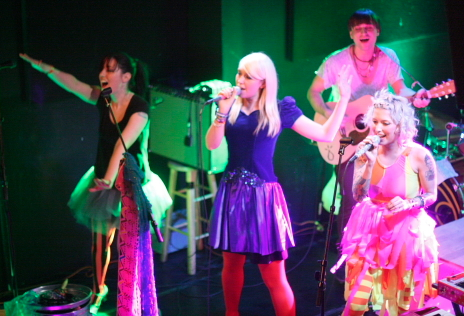
The other night, on a Sunday in Lawrence, I walked down the street and watched the band, Tilly and the Wall, perform at a place called the Jackpot Saloon.
This was surprising for a few reasons, namely that I didn’t know that Tilly and the Wall was still a thing. So, yes, that would have to rate as the most surprising aspect of the night. A little background: When I was in college, I worked for the student radio station at KU, KJHK, perhaps the most hipster thing in a really fucking hipster town.
I was on the sports staff, mostly doing play-by-play for KU basketball games, and occasionally going to staff meetings that looked like the editorial staff at VICE went to a bar in Greenpoint and the whole thing exploded into one mess of scarves and glasses and plaid shirts from the 1970s.
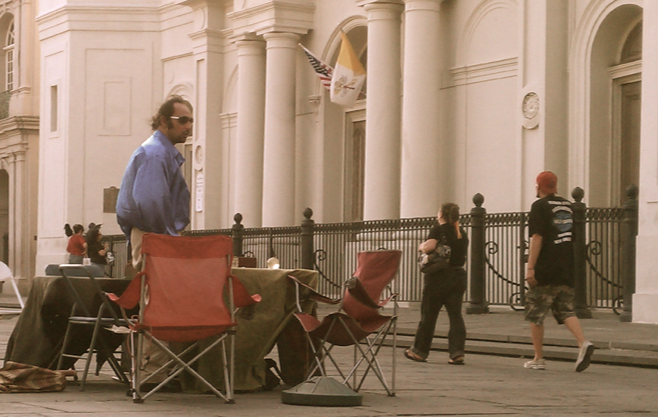
NEW ORLEANS — The Gypsy Man in the blue shirt was shouting, his voice careening off walls and into empty alleys.
“I’m the fucking gazda,” he would say.
It wasn’t quite a scream, or a bellow, or even a holler. It was a quiet shout, if such a thing exists. And he was directing his seeming anger toward a young woman named Gina. I can’t say that Gina was strung out. But she looked it. Her skin was brown, but maybe just a tick too translucent. Her teeth were a mangled mess. Her hair was thinning and brittle. More than that, she appeared disoriented — the toxins in her body winning a battle over the healthy endorphins, if such a chemical process is even possible.


 The Brew House